


Greetings fellow Methuselahs,
Welcome to this newsletter. Above you see the group photo from the European Championship of Vampire: The Eternal Struggle, held in Vilnius on September 19-20 with 196 players. Thanks to all of you lovely people, and thanks to the organisers. Hope to see everyone again next year in Gelsenkirchen, Germany.

The European Championship 2027 will be in Gelsenkirchen, Germany!
In Vilnius, it was announced that next year's EC will be played in Gelsenkirchen, North Rhine-Westphalia, on October 29–31. We will continuously report the most important updates about this event, as will other channels, but for the most recent, updated information always consult the official website ec27.vtes.de!

The Archon app is now the official way to handle VEKN tournaments
Here is the official statement from Vincent Ripoll in full:
"Dear Methuselahs, dear organizers,
The Archon app is now the official way to handle your tournaments!
The app passed its trial by fire during the 2026 European Championship in Vilnius and is now replacing the old Excel-based tournament management system after nearly 25 years of loyal service.
Let’s take this opportunity to thank one last time those who have worked on it over the years: LSJ, Dominic Catanzariti, François Alix, Stéphane Lavrut, Jeff Thompson, Jussi Hattara, Karl Schaefer, David Tatu, Kevin Mergen, Vincent Ripoll, Pascal Bertrand, Emiliano D’Onofrio, and Lionel Panhaleux (if I’ve forgotten anyone, please raise your hand!).
It is no longer possible to create new tournaments using the old system, but tournaments that have already been created can still be finalized using the old system if necessary.
Thanks to Lionel “Phoenix” Panhaleux for his excellent work!
If you haven't reclaimed your VEKN number on the app, now is the right time!
This also means that updates to the Tournament Winning Decks (TWD) will primarily be done through the app, which will speed up the process since there should no longer be any data entry errors and the process can therefore be fully automated.
There are still a few details to finalize regarding the TWDs, which explains the delay in the update; we’ll keep you posted.
The VEKN team"
So that's it - the old calendar will be removed in a while, and the old Excel Archon is not to be used any more. The Archon is dead, long live the Archon!

Héctor Javier Ordoñez is the 2026 European champion!
This tournament was played in Vilnius, Lithuania on September 19-20 with 196 players.
Read the full report: European Championship 2026

Player interview: Héctor Javier Ordoñez, European champion 2026
Congratulations, Hector! Thanks for taking the time to talk to us. A little background first: how long have you been playing this fantastic game that you obviously now have mastered?
- I used to go to a game club to play Magic, Dungeons & Dragons and Vampire: The Masquerade, among other things. For a while, I even ran Vampire roleplaying sessions! It was around 2002 when my friends and I were introduced to VTES, and we started playing among ourselves.
Our English wasn’t very good back then, so we did what we could. I remember playing Voter Captivation not knowing that you can only take 2 pool! Awe + Voter Captivation was a pretty nice combo haha!
Do you have a regular local group where you live?
- I mostly play around Utrecht, in the Netherlands. We have a pretty regular group, usually with one table per week, sometimes two. The meta is quite diverse, with competitive players and more casual. You can encounter anything from Tupdogs to Ravnos bleed.
Did you get a chance to play in the Week of Nightmares this year, or the Friday Grand Prix?
- I have never attended a Week of Nightmares, but I did play the Friday GP and reached the final. That was very nice, because it meant I could play Saturday with less pressure. So I wasn't that exhausted – I think I was mostly ok, but by the time I was playing the final on Day 2 I was starting to glitch :)
So how was your EC Day 1?
- Since I was already qualified through the Friday GP final, I approached Saturday with less pressure and tried to conserve energy for Sunday. I played a fairly conventional G6 Tzimisce deck with eleven bounce cards, hoping to take advantage of the bleed-heavy meta I expected on Day 1.
I didn’t fare so well, at one table I was sandwiched between two politicals (one of them Nikica’s), and in another I was the unfortunate prey of a Path of Caine rush deck. Neither was really something the deck is prepared for!
How did you decide on a deck for the EC Day 2 tournament? Tell us all about it!
- Mainly I wanted to play something of my own design that I would enjoy, no matter if I won or lost. I expected a very diverse meta with experienced players bringing personal variations of known archetypes and some surprises.

I had played my deck “Baby meeting” around ten times, but only on Lackey, no in-person games. I liked the idea that people seeing my Ministry crypt would think “It is just a Platinum Protocol deck”, although by the final, other players probably knew what I was doing!
As for strengths, the deck is very explosive, which is a strength but also a weakness, since it tends to draw attention. You need to know how to manage that. Also, in late game the deck has many, many options. If you have a Garibaldi or a Sargon you can be quite creative with what you can do.
About weaknesses... Early pressure can be problematic, especially before you can develop your board and play strong Consanguineous Boons. It is also difficult if there are votes at the table in the hands of people who want you out. Another problematic point is consistent blockers. The deck is very slippery, since it does many actions per turn, so it is hard to block everything. It does not pack much stealth, which I think should be saved for key actions like Heart of Nizchetus, Consanguineous Boon or Revolutionary Council.
What are the key cards?
- Heart of Nizchetus is particularly valuable because the order of the cards matters, even though the deck already cycles plenty of cards. You want the right sequence: Childe of the Revolution, CrimethInc, Waters of Duat. If you have Waters and CrimethInc, and Childe arrives later, it does not work.
What are the ideal prey and predator?
- The ideal prey is a strong bleeder, since they will get the aggro and I might even get encouragement from the table to kill them.
All predators are bad :D but if I had to choose, anything that does not block too much or is too fast.
What was your experience during the 3 preliminary rounds of Day 2?
- At the first table, Marcus was bleeding me with his Ravnos and my prey Denes was playing Brujah Debate. It was a tense game. At one point I played a Consanguineous Boon for Marcus to keep him in the game in exchange for him not bleeding me.
Second table was tough, with Richard piloting his Capuchin deck as prey and Tomasz with a Nephandi deck as predator. At some point Tomasz played Frontal Assault and torporised all 6 of my minions!
Third table was with Norbert, with Ravnos bleed, as prey and Leonardo with an original Lasombra breed deck that unfortunately struggled to develop until late in the game.
All games were very nice and enjoyable. Even when positions or negotiations were difficult, we laughed and had a really good time!

In the final, what was your seed and what did you think of your position at the table?
- As third seed in the final, I felt my seating options were limited. I sat as predator of Bram, preferring the scenario where he had to backrush me to defend himself rather than him having to rush me to get his point.
Were you familiar with the other players?
- With Nina and Tero I have played a few times before, with Lech only online. Bram and I have played countless games over many years, and I consider him a friend. His Qawiyya multi-rush deck worried me a lot. Looking at the table, I honestly thought my fate was already determined.
How was the early game shaping up?
- My opening was explosive. I brought out a six-cap who had a perfect first turn: Fee Stake, CrimethInc, Childe, CrimethInc, Waters. By the time Qawiyya could act, I had four minions.
Bram wanted to talk before torporising everything on my board. Going backwards would probably mean ruining both our games while the rest of the table develops. So I offered not to do anything forward until he gets his first victory point.
I planned on honouring that deal. I expected Bram to push forward against Nina, and I also had the possibility of ousting her with Revolutionary Council myself, giving Bram his point and releasing me from the deal.
What was your sense of the table mid-game?
- Mid-game was frustrating. Lech played a Direct Intervention and four (!) Delaying Tactics against my attempts to play Consanguineous Boon.
Tero’s The Unnamed wasn’t putting much pressure on Lech’s Harbingers, so Lech had room to develop his board. I had to block Emerald Legionnaire bleeds, which meant spending many actions rescuing vampires from torpor and hunting.
In the meantime Bram did not seem to get close to ousting Nina, and Revolutionary Council was not showing up.
At some point I was at seven pool and in danger of being ousted by Lech. Bram intervened with cross-table rushes to keep me alive. If Lech obtained a victory point, Bram would need two points to win.
Then Revolutionary Council shows up, and at seven minutes left, my turn begins. I know I will not have another turn after this. I will have to make a decision: to honor the deal until the end and lose, or break the deal and win.
I play Revolutionary Council. Lech plays Direct Intervention. I trust the God of cards; play Childe, play Dual Form, bleed with Propaganda, and here it comes: a Sargon Fragment. I play Sargon Fragment, unlock with CrimethInc paying a pool, use it to fetch the Revolutionary Council, play Revolutionary Council.
Target: Bram.
That was dramatic indeed. So to round this off, what do you see in VTES’s future? For you, and for the game?
- Having seen VTES in its darkest years, I am very happy to see how strong the community and the competitive scene are.
For me the appeal is still discovering ideas, building new decks, seeing whether I can make it work. The upcoming sets and the Sabbat paths give us more possibilities for that, and I enjoy seeing the meta change.
Regarding helping the game grow: I think we should make it as easy as possible for interested people to find a game in their city. They need to know who to contact, where to borrow decks, etc.
And for a game so complicated, I would love to see some outstanding tutorials. For example, there is a Netrunner tutorial that is immersive, accurate, and interesting. Something similar for VTES could help turn interest into players, in my opinion.
Finally, a big thank you to the organisers, judges and players. It was an amazing EC. I am grateful that every year we all agree we should go somewhere, sit together, stab each other in our hearts, and laugh about it. To share this unique, extraordinary game with you all is an honour. Thank you.
Thank you, Héctor. A very strong weekend for you – good luck in the future!

Daniel Magda is the 2026 Czech champion!
Played in Pelhřimov on September 5 with 53 players.
Read the full report: Czech Republic National Championship 2026

Alex Shoemark is the 2026 UK champion!
Played in Nottingham on September 5 with 25 players.
Read the full report: UK National Championship 2026

Nick Miller wins Grand Prix Sydney 2026!
Played with 16 Methuselahs on September 5.
Read the full report: Grand Prix Sydney 2026

Louis Emerson Tong is the 2026 champion of Singapore!
The tournament was played at Gamersaurus Rex (!) in Singapore City on September 19. Only 9 players in the battle - better luck next year!
Read the full report: Singapore National Championship 2026
 Welcome to Festivo dello Estinto 8 in Zaragoza!
On November 6-8, Festivo dello Estinto returns for its eighth edition. In this VTES storyline tournament, special rules favour the Sabbat and the results feed back into the World of Darkness narrative. Black Chantry created a special full art version of Crusade: Aragon for this event, but that is far from all you get by attending - there will be special tournament cards, VTES artist guests, side events, tin deck boxes, barbecues, Vaulderie (!) and all kinds of other fun in this Zaragoza weekend. The winner gets the prize ring, a complete Sabbat Wars set, and the chance to become the face of next year's Sabbat Convert card.
For more details and to register, check out vtes-zaragoza.com!

CometCon 2026 - a VTES celebration!
On September 5-6, the game convention CometCon was held in Gijón, Spain. This time it had two nice VTES events, a standard constructed tourament and a 2-player variant one that was extra successful - people loved it! Read all about it in the report by Daniel Méndez, VEKN Prince of Gijón.
 |
 |
Succubus Club to the left, Elysium to the right.
Great VTES content
A few years ago, it was rather easy to keep up with great VTES-related content online - especially if you were mainly interested in English-language content. Now, to our great joy, it's practically impossible! But here are some recent picks:
• The Thessalian Scrolls gathers some interesting statistics on tournament games.
• Succubus-club.net seems like a strong competitor to Lackey for playing VTES online.
• Elysium is another new tool for the same thing - which one is best?!
• Ratcat is a newish Youtube channel that helped out with streaming games from the Vilnius EC. Also has funny memes!
• If you are a fan of old-school card game art, check out artist Randy Gallegos's Substack - sometimes about VTES.
Do you know about something we should highlight in this section? Contact the editor at !

Reminder: Please join the World of Darkness Community Map!
Please advertise your VTES playgroup and/or VTES events on the World of Darkness Community Map! This is important to help the game grow. But list only things that happen in public places where anyone is welcome - nothing played at someone's home, and no online events.
Check out the map here: World of Darkness Community Map
Submit here: Map submission form

Black Chantry Summary: September 2026
• Noites Brasileiras and Secrets of New York now have an official release date, October 31. Your local store might sell them before that, but that is the first date when the new cards are allowed in VEKN sanctioned tournaments. Also, check out the announcement post for a listing of all the set artists!
• Henrik, Hugh and Vincent of Black Chantry attended the EC in Vilnius and would like to thank the hosts for a very well-organised event. There was a small presentation and Q&A focused on the recent survey results and current plans for the game. Great times as usual, playing games and talking to players and artists!
• Product Director Ben Peal will appear at the South American Championship in Brasilia, Brazil on October 10-11, and would love to see you there! He has prepared a presentation - make sure to prepare some tricky questions to ask him!
• The full art promo card Crusade: Aragon, made for Festivo dello Estinto (see above in this newsletter), has been added to the print-on-demand at Gamepod and can be ordered by any National Coordinator.
• The third round of playtesting of two preconstructed decks for a 2-player variant of VTES has just started. Several art pieces for this are already completed, which will be used one way or another.
• Design of "Anthology II" and New Blood packs for the four Sabbat paths continues. New art for some Anthology cards that need it has been commissioned or is already delivered. New Blood playtesting will start shortly.
• Want to know more about future releases? Dates are a bit off, but the product roadmap article at Blackchantry.com is still relevant.


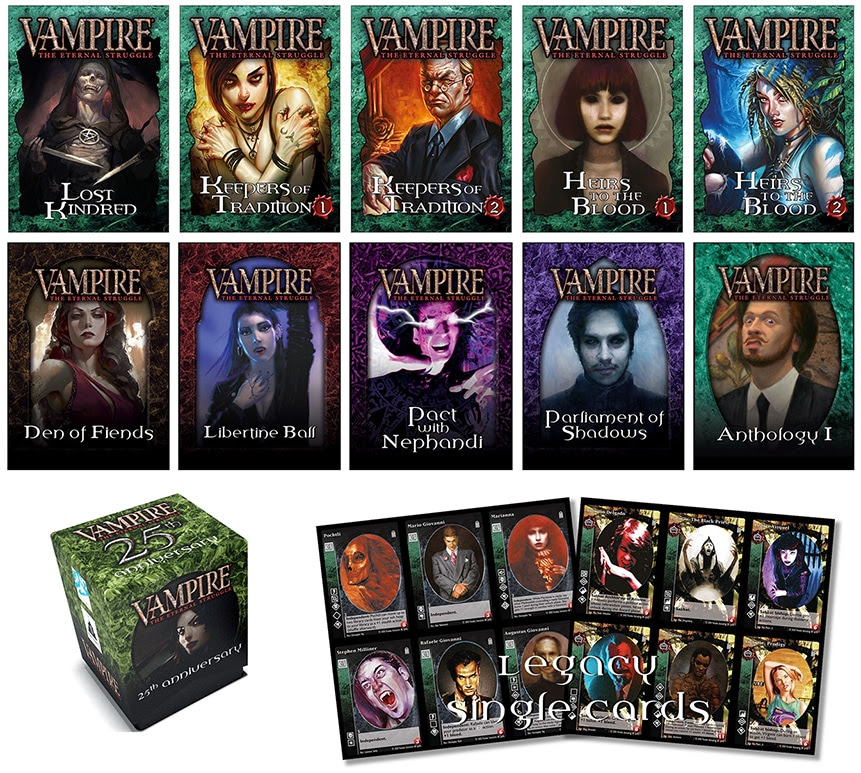
• The following Black Chantry products are currently available through Gamepod, Drivethrucard
Lost Kindred bundle (Drivethrucards and Gamepod only)
Keepers of Tradition Reprint Bundle 1 (Drivethrucards and Gamepod only)
Keepers of Tradition Reprint Bundle 2 (Drivethrucards and Gamepod only)
Heirs of the Blood Reprint Bundle 1 (Drivethrucards and Gamepod only)
Heirs of the Blood Reprint Bundle 2 (Drivethrucards and Gamepod only)
Den of Fiends Preconstructed Deck (Also Spanish, French) (Drivethrucards and Gamepod only)
Libertine Ball Preconstructed Deck (Also Spanish, French) (Drivethrucards and Gamepod only)
Pact with Nephandi Preconstructed Deck (Also Spanish, French) (Drivethrucards and Gamepod only)
Parliament of Shadows Preconstructed Deck (Also Spanish, French) (Drivethrucards and Gamepod only)
Anthology I bundle
VTES Card Creator (Drivethrucards only)
25th Anniversary
First Blood: Malkavian (Also Spanish, French) (Drivethrucards and Gamepod only)
First Blood: Nosferatu (Also Spanish, French) (Drivethrucards and Gamepod only)
First Blood: Toreador (Also Spanish, French) (Drivethrucards and Gamepod only)
First Blood: Tremere (Also Spanish, French) (Drivethrucards and Gamepod only)
First Blood: Ventrue (Also Spanish, French) (Drivethrucards and Gamepod only)
VTES Legacy Card Singles (Drivethrucards and Gamepod only)
Promo Pack 1 (Drivethrucards and Gamepod only)
Promo Pack 2 (Drivethrucards and Gamepod only)
Promo Pack 3 (For promotion only)
Promo Pack 4 (For promotion only)
VTES "Parity Shift" playmat
VTES card sleeves
Vampire: The Eternal Struggle Fifth Edition (Stores only)
Vampire: The Eternal Struggle Fifth Edition Latin (Drivethrucards only)
Fifth Edition: Malkavian (Also Spanish, French, Latin)
Fifth Edition: Nosferatu (Also Spanish, French, Latin)
Fifth Edition: Toreador (Also Spanish, French, Latin)
Fifth Edition: Tremere (Also Spanish, French, Latin)
Fifth Edition: Ventrue (Also Spanish, French, Latin)
Fifth Edition: Banu Haqim (Also Spanish, French, Latin)
Fifth Edition: Brujah (Also Spanish, French, Latin)
Fifth Edition: Gangrel (Also Spanish, French, Latin)
Fifth Edition: The Ministry (Also Spanish, French, Latin)
New Blood: Malkavian (Also Spanish, French, Latin)
New Blood: Nosferatu (Also Spanish, French, Latin)
New Blood: Toreador (Also Spanish, French, Latin)
New Blood: Tremere (Also Spanish, French, Latin)
New Blood: Ventrue (Also Spanish, French, Latin)
The Fall of London (Also Spanish, French, Latin)
Echoes of Gehenna
Shadows of Berlin (Also Spanish, French)
New Blood: Banu Haqim (Also Spanish, French)
New Blood: Brujah (Also Spanish, French)
New Blood: Gangrel (Also Spanish, French)
New Blood: The Ministry (Also Spanish, French)
Fifth Edition: Ravnos (Also Spanish, French)
Fifth Edition: Salubri (Also Spanish, French)
Fifth Edition: Tzimisce (Also Spanish, French)
30th Anniversary (Also Spanish, French)
Fifth Edition: Lasombra (Also Spanish, French)
Fifth Edition: Hecata (Also Spanish, French)
New Blood: Hecata (Also Spanish, French)
New Blood: Lasombra (Also Spanish, French)
Path of Caine (Also Spanish, French)
Path of Cathari (Also Spanish, French)
Path of Death and the Soul (Also Spanish, French)
Path of Power and the Inner Voice (Also Spanish, French)
New Blood: Ravnos (Also Spanish, French, Brazilian Portuguese)
New Blood: Salubri (Also Spanish, French, Brazilian Portuguese)
New Blood: Tzimisce (Also Spanish, French, Brazilian Portuguese)
Noites Brasileiras (Also Spanish, French, Brazilian Portuguese) (Upcoming)
Secrets of New York (Also Spanish, French) (Upcoming)
Do you have opinions about or questions for Black Chantry? Start a topic on the VEKN forum, or contact the company by e-mail, Facebook, Instagram

Recent news in the World of Darkness
The annual “Month of Darkness” is on! This year there is a lot going on, all summarised in this post on Worldofdarkness.com. Sales, creative prompts, BEAUTIFUL metal dice and many other things.
A third Dev Diary on the next edition of Vampire: The Masquerade was published. In it, Creative Director Jess Lanzillo describes some of what the team learnt during the 1.0 Alpha playtest and some of the plans moving into 2.0. Most of these are game-mechanical things with very little obvious effect on VTES. The most interesting thing is maybe that the most mentioned discipline in the playtest feedback was Protean – a discipline that was not in the playtest, was heavily emphasised in V5 (and thus also VTES Fifth Edition), and that now seems to be removed from the game. Interesting times indeed!
Looking for more World of Darkness in your channel of choice? Check out the Linktree!
Calendar
Major events coming up:
October 10: Continental Championship South America, Brasilia, Brazil
October 11: Continental Championship Asia, Tokyo, Japan
October 17: Continental Championship Oceania, Brisbane, Australia
October 17: Grand Prix Pittsburgh, USA
October 18: Appalachian Cup Grand Prix final, Bethel Park, USA
October 24: Grand Prix New Orleans, USA
October 31: National Championship France, Nancy
October 31: National Championship Netherlands, Doorn
November 7: National Championship Sweden, Stockholm
November 7: National Championship Switzerland, Zürich
November 7: National Championship Slovakia, Bratislava
November 7: National Championship Denmark, Køge
November 15: National Championship Mexico, Mexico City
November 21: National Championship Canada, Montréal
November 28: National Championship Germany, Herne
November 28: National Championship Hungary, Budapest
December 5: Grand Prix Vidor, USA
December 13: Grand Prix Cearense, Brazil
Tournaments for the coming month (registered at the time of writing) are in:
Australia x4
Brazil x8
Canada
Chile x2
Croatia
Finland x3
France x2
Germany x2
Greece
Hungary x5
Italy x3
Japan
Netherlands
Online x2
Portugal x3
Serbia x2
Spain x10
South Africa
Sweden
UK
USA x9
For details about these events, see either Archon.vekn.net or the VEKN Event Calendar - the Archon app will gradually replace the calendar. Also, check out the World of Darkness Community Map.
Remember: Online tournaments are possible - just check the box "Online tournament" when you add the event to the calendar!
Contact VEKN
You can contact the VEKN Inner Circle members using the contact forms at VEKN.net. Also follow the official VTES Facebook page Vampire: The Eternal Struggle, the official VEKN X account @VEKN_VTES and the official VTES Discord server.
Wisdom comes with age. But sometimes age comes alone.

Greetings fellow Methuselahs,
Welcome to this newsletter. As has become custom, we start off with an art and card preview. Chave de Braço ("armlock") is a card from the upcoming Noites Brasileiras set, in stores in October. The illustration is by Carlos Diaz, truly great stuff, check out more of his work on his Instagram @shogunkamyu


South American Championship coming up
Welcome to the SAC 2026! The tournament will be played at Utopia Games & Food in Brasilia, Brazil on October 10. A special full art version of Luana do Lago is awarded to all participants. More information is in the VEKN Event Calendar.

The schedule for EC 2026 is ready!
There are only a couple of weeks left now until the largest (?) VTES event of the year, the European Championship in Vilnius, Lithuania. The main event is on weekend, but the "Week of Nightmares" tournaments run daily September 14-17, and new for this year is that the Friday event is a full-fledged three-round Grand Prix tournament! And not only that: all five finalists from Friday automatically qualifiy for EC Day 2 AND the winner qualifies for a seat at the Grand Prix final played on Saturday night! Keep up to date with the latest news on the official EC website.

Heimo Wurzer wins Grand Prix Vienna 2026!
74 players from 16 countries attended this event in Austria on July 18.
Read the full report: Grand Prix Vienna 2026

Joey Theriot wins Grand Prix Biloxi/Gulfport 2026!
This tournament was played with 19 attendees in Gulfport, Mississippi on August 8.
Read the full report: Grand Prix Biloxi/Gulfport 2026

Vladislav Ignatenko is the 2026 champion of Russia!
This tournament was played in Saint Petersburg on August 1 with 16 players.
Read the full report: Russia National Championship 2026

Meet the VEKN: Alexandre Bustros, National Coordinator of Canada
Firstly: BIG thanks to all who volunteer for the VEKN! Without your work this organisation would not function, so we will try to put the spotlight on you, for example in the newsletter.
Hello Alexandre! Let's take it from the beginning: When did you start playing VTES?
I started playing in 1994 ... The first game I played was awful because I was playing with a starter deck which was, back then, a mostly incompatible mix of cards. After a while we all had enough cards to build some playable decks. I had a Malk and a Gangrel deck.
In the first month that my playgroup and I were introduced to the game, we had to figure out the rules without access to the web because in the 90s there was no internet like there is now. There was a typo in the Auspex card Read Intentions; the text was "Dodge" instead of "Strike: Dodge". We assumed that it was free dodge, one that does not require a strike. I remember a game in which Ozmo was in combat against Masika equipped with a Flamethrower. Masika played Blur and Ozmo managed to dodge 3 times with 3 Read Intentions! Epic game :)

I have to admit that, to me, this game is partly nostalgia, partly strategy. I like to play with the old cards from the 90s and early 2000s. In a tournament another player was playing Basilia and Wynn, I had a lot of respect for that - it made my day!
What do you like most about the game?
I like playing the game. It’s challenging! The World of Darkness was a great fictional universe to build a card game on. Aside from that, I think it’s a very balanced game. There is no perfect combo; you always have a flaw. I also enjoy the "full hand" mechanism that makes you redraw when you play a card. Also the multiplayer predator/prey aspect of the game is just well thought out. It's a great game design. And I also have to mention that I like the endless deck-building possibilities of this game.
Do you have an all-time favourite deck?
That’s a tough question. I like to try random mechanics! I still like to play Gangrel and Malkavian both old school and V5. When I want to win, I like to play the new V5 decks. My current favourite is the new Tzimisce with Dominate, Protean and War Ghoul (War Ghoul is a discipline, right?) Aside from that, I have to admit that I like to play Blood Brothers, even if it’s not an easy play. I also built a !Salubri deck as a bet and I enjoy playing it more than I thought.
Anything else you have cooking in the deck workshop right now?
I am trying to build a deck with the new Gilbert Duane and Magnums. I thought after all these years it would be nice if he could have a more functional weapon than a water pistol.
Do you think you have a special style of playing?
I see deck building as a part of the game. I enjoy making decks with an original twist, something that you do not normally see at a table. It’s my pleasure to build decks where I can surprise other players with an unexpected card. That being said, when I want to be more competitive, I like to play tap and bleed.
You are the newly appointed National Coordinator – congratulations on this honourable assignment! What do you currently do, and plan to do, to spread VTES in your country?
I organized the 2024 Canadian National Championship in Montreal and I was happily surprised that 24 players showed up for the event. From then on I realized that there was a lot of interest in the local playgroup.
This year has been a great year for VTES in Canada: there were TWO tournaments on the same day! One in the west in Calgary and one in the east in Montréal. The game is gaining momentum in the Great White North! I hope we have more tournaments in the years to come.
It would be fun to have more Canadian cities organize official tournaments. Perhaps one day we could have a Canadian coast to coast Grand Prix event with an online final.
That sounds like an excellent idea Alexandre, good luck with making that happen, and with everything as the National Coordinator.
We urge all National Coordinators who could endure being interviewed for the newsletter to contact the editor at . If they are too shy to speak up, we perhaps need to talk to Princes instead! :)

Reminder: New Archon and Judges’ Guide
As presented last month, there is a new Archon and also a new VEKN Tournament Conduct & Infraction Guide. Check them out! Because of this, we continue our little article series...
Rule reminder: How to act as a spectator
Sure, VTES is a rather relaxed game with not much but glory at stake, but still: it is a competitive game. At big tournaments, people might have traveled a long way to attend and enjoy their time. So as a spectator, you are generally to keep quiet. Even if you don't understand it yourself, what you say can affect the game, maybe by reminding a player of something, or by distracting or disturbing.
The relevant section in the Tournament Rules is “2.4. Spectator Responsibilities”: "A spectator of a game is defined as any person other than a judge or an organizer who is not playing in that game. A player who is ousted from a game is considered a spectator for the remainder of the round. All spectators are expected to remain silent during the course of a game and are not permitted to communicate with players in any way while a game is in progress. Spectators who believe that they have observed rules violations should inform a judge, but they must not interfere with the game. Players have the right to request that any spectator not observe their game. All such requests must be made through a judge, who may grant or deny the request as he or she sees fit. The judge or organizer may choose to prohibit all spectators at any table(s) or round(s) of the tournament."
The fresh Judges guide states in section 1.1.4 that "Disqualification may also apply to non-players (spectators, staff, etc.) whose behavior compromises the event."
And also in section 3.2 about outside assistance: "A player, spectator, or other tournament participant commits Outside Assistance if, after a game has started, they provide or receive strategic, tactical, or hidden information input that could influence decisions in an ongoing game, or if they reference pre-prepared strategic materials while the round is in progress." That section then goes on with philosophy, examples and guidelines for penalties.
This can of course mean tricky calls for judges, so please help them out by not creating these situations. Please respect these rules and your co-players!

Recruitment exercise: Tablecon Quest 2026, Singapore
On August 1-2, four volunteers ran a demonstration table at Tablecon Quest, the largest dedicated tabletop gaming convention in Singapore. This was a very well-planned and documented event - we highly recommend anyone interested in organising demo games to read the full report from Keith Lee, National Coordinator of Singapore. Goals, preparations, deck designs, key observations, all you need, it's all in there. Great job!
Do you want to help recruit players? Send an email to to see if you can get help with materials!

Reminder: The VEKN Newsletter Contribution Award promo card
To encourage newsletter contributors to send in material on time, a special award card has been produced. This first one is a version of Malkavian Rider Clause, unique with a yellow symbol in the right-side corner.
This card will be printed in very limited numbers, maybe about 50-100 per year. It will be awarded to a) tournament organisers of events at Continental, National or Grand Prix level who e-mail their tournament reports to the editor within 7 days of the event, and b) other contributors of material that has been agreed on with the editor. So no point in sending in random stuff before asking first! Cards will be awarded at the earliest convenient opportunity, maybe at a Continental tournament, otherwise sent to you by registered mail.
We hope this will help motivate volunteers that are already doing heroic deeds for VTES!
Reminder: Please join the World of Darkness Community Map!
Please advertise your VTES playgroup and/or VTES events on the World of Darkness Community Map! This is important to help the game grow. But list only things that happen in public places where anyone is welcome - nothing played at someone's home, and no online events.
Check out the map here: World of Darkness Community Map
Submit here: Map submission form
Black Chantry Summary: August 2026
• News on print-on-demand: One new art version of Rexton “Savage” Abernathy (for everybody) and two National Championship promos (for organisers of such tournaments) have been made available at Gamepod.es, and Drivethrucards soon too.
 |
 |
 |
• The full content lists for Noites Brasileiras and Secrets of New York are now up on their respective product pages at Blackchantry.com, as is all of the so far revealed cards. Thanks to all the 20 (!) different content creators that have been helping out with the previews. Note that if you have a special interest in the card artwork and the artists, the Black Chantry account on Instagram is worth a check!
• The second round of playtesting of two preconstructed decks for a 2-player variant of VTES started on August 24. The design team is looking forward to the test feedback!
• Design of "Anthology II" and New Blood packs for the four Sabbat paths continues.
• Want to know more about future releases? Dates are a bit off, but the product roadmap article at Blackchantry.com is still relevant.
• The following Black Chantry products are currently available through Gamepod, Drivethrucard
Lost Kindred bundle (Drivethrucards and Gamepod only)
Keepers of Tradition Reprint Bundle 1 (Drivethrucards and Gamepod only)
Keepers of Tradition Reprint Bundle 2 (Drivethrucards and Gamepod only)
Heirs of the Blood Reprint Bundle 1 (Drivethrucards and Gamepod only)
Heirs of the Blood Reprint Bundle 2 (Drivethrucards and Gamepod only)
Den of Fiends Preconstructed Deck (Also Spanish, French) (Drivethrucards and Gamepod only)
Libertine Ball Preconstructed Deck (Also Spanish, French) (Drivethrucards and Gamepod only)
Pact with Nephandi Preconstructed Deck (Also Spanish, French) (Drivethrucards and Gamepod only)
Parliament of Shadows Preconstructed Deck (Also Spanish, French) (Drivethrucards and Gamepod only)
Anthology I bundle
VTES Card Creator (Drivethrucards only)
25th Anniversary
First Blood: Malkavian (Also Spanish, French) (Drivethrucards and Gamepod only)
First Blood: Nosferatu (Also Spanish, French) (Drivethrucards and Gamepod only)
First Blood: Toreador (Also Spanish, French) (Drivethrucards and Gamepod only)
First Blood: Tremere (Also Spanish, French) (Drivethrucards and Gamepod only)
First Blood: Ventrue (Also Spanish, French) (Drivethrucards and Gamepod only)
VTES Legacy Card Singles (Drivethrucards and Gamepod only)
Promo Pack 1 (Drivethrucards and Gamepod only)
Promo Pack 2 (Drivethrucards and Gamepod only)
Promo Pack 3 (For promotion only)
Promo Pack 4 (For promotion only)
VTES "Parity Shift" playmat
VTES card sleeves
Vampire: The Eternal Struggle Fifth Edition (Stores only)
Vampire: The Eternal Struggle Fifth Edition Latin (Drivethrucards only)
Fifth Edition: Malkavian (Also Spanish, French, Latin)
Fifth Edition: Nosferatu (Also Spanish, French, Latin)
Fifth Edition: Toreador (Also Spanish, French, Latin)
Fifth Edition: Tremere (Also Spanish, French, Latin)
Fifth Edition: Ventrue (Also Spanish, French, Latin)
Promo Pack 3 (Event promos only)
Fifth Edition: Banu Haqim (Also Spanish, French, Latin)
Fifth Edition: Brujah (Also Spanish, French, Latin)
Fifth Edition: Gangrel (Also Spanish, French, Latin)
Fifth Edition: The Ministry (Also Spanish, French, Latin)
New Blood: Malkavian (Also Spanish, French, Latin)
New Blood: Nosferatu (Also Spanish, French, Latin)
New Blood: Toreador (Also Spanish, French, Latin)
New Blood: Tremere (Also Spanish, French, Latin)
New Blood: Ventrue (Also Spanish, French, Latin)
The Fall of London (Also Spanish, French, Latin)
Echoes of Gehenna
Shadows of Berlin (Also Spanish, French)
New Blood: Banu Haqim (Also Spanish, French)
New Blood: Brujah (Also Spanish, French)
New Blood: Gangrel (Also Spanish, French)
New Blood: The Ministry (Also Spanish, French)
Fifth Edition: Ravnos (Also Spanish, French)
Fifth Edition: Salubri (Also Spanish, French)
Fifth Edition: Tzimisce (Also Spanish, French)
30th Anniversary (Also Spanish, French)
Fifth Edition: Lasombra (Also Spanish, French)
Fifth Edition: Hecata (Also Spanish, French)
New Blood: Hecata (Also Spanish, French)
New Blood: Lasombra (Also Spanish, French)
Path of Caine (Also Spanish, French)
Path of Cathari (Also Spanish, French)
Path of Death and the Soul (Also Spanish, French)
Path of Power and the Inner Voice (Also Spanish, French)
New Blood: Ravnos (Also Spanish, French, Brazilian Portuguese)
New Blood: Salubri (Also Spanish, French, Brazilian Portuguese)
New Blood: Tzimisce (Also Spanish, French, Brazilian Portuguese)
Noites Brasileiras (Also Spanish, French, Brazilian Portuguese) (Upcoming)
Secrets of New York (Also Spanish, French) (Upcoming)
Do you have opinions about or questions for Black Chantry? Start a topic on the VEKN forum, or contact the company by e-mail, Facebook, Instagram

Recent news in the World of Darkness
As this is being written, the first round of alpha playtesting of a new edition of Vampire: The Masquerade has just concluded. The results haven't been analysed fully yet, but there was a Dev Diary by Creative Director Jess Lanzillo published on August 24. The most VTES-relevant aspects (like change of clan disciplines AGAIN) is not in focus. Some key things:
• The point of releasing such a rough Alpha was deliberately experimental — throw a lot of new mechanics out to see what sticks and what players reject, rather than designing from the team's own assumptions about what Vampire fans want.
• "Maturing" disciplines seem to be a hit. Pairing them with Blood Surge, which lets you push a power to its next tier at a cost, creates a satisfying choice-and-consequence dynamic, and it reduces cognitive load by letting build-focused players invest early in something while still using the power in the meantime.
• The "Drama" metacurrency seems to be a miss, as it breaks immersion and the game already has dread-generating systems.
An Alpha 2.0 round of playtesting is promised to start sometime in September!
Looking for more World of Darkness in your channel of choice? Check out the Linktree!
Calendar
Major events coming up:
September 5: Grand Prix Sydney, Australia
September 18: Grand Prix Vilnius 2026, Lithuania
September 19: European Championship 2026, Vilnius, Lithuania
October Date TBD: Grand Prix New Orleans, USA
November 7: National Championship Sweden, Stockholm
November 28: National Championship Germany, Herne
December 13: Grand Prix Cearense, Brazil
Tournaments for the coming month (registered at the time of writing) are in:
Australia
Brazil x8
Chile
Czech Republic
Finland
Hungary
Italy x3
Lithuania x8
Poland
Serbia
South Africa
Spain x5
USA x3
For details about these events, see the VEKN Event Calendar. Also, check out the World of Darkness Community Map.
Remember: Online tournaments are possible - just check the box "Online tournament" when you add the event to the calendar!
Contact VEKN
You can contact the VEKN Inner Circle members using the contact forms at VEKN.net. Also follow the official VTES Facebook page Vampire: The Eternal Struggle, the official VEKN X account @VEKN_VTES and the official VTES Discord server.
When there is no enemy within, the enemies outside cannot hurt you.
Written by Keith Lee, National Coordinator of Singapore:
On August 1st and 2nd, 2026, a team of four volunteers from the VTES community ran a demonstration table at Tablecon Quest, the largest dedicated tabletop gaming convention in Singapore. Two months of work had gone into preparing for this event, and the results exceeded our expectations. Here follows a brief report of the event, for the benefit of others planning to demo VTES to a wider audience.
Our goals
- Introduce as many people as possible to VTES and the World of Darkness.
- Focus on creating an engaging experience as opposed to a focus on rules and mechanics.
- Leave a strong positive impression of the game within the span of a 30–45-minute demo.
- Encourage demo participants to join our local community channels/chat group, for continuity.
Preparations
A couple of months before the convention, we began looking into the best ways for us to enter the event. The cost of a full exhibition booth was of course prohibitive for a team of volunteers, so we instead felt it best to rent one of the tables that the event was offering in their Demo Area. In the end however, we had the good fortune to receive support from HammerHouse, a local game store and the Asian regional distributor for VTES. As they themselves were planning to exhibit at the event, not only did they sponsor the costs for our demo table, but we were able to place the table within their large booth, benefitting from their presence as a much more well-known entity in the local tabletop scene.
With the largest cost out of the way for us, we turned our attention to the following prep work, which took the remainder of the two months we had before the event:
- Creating and testing five beginner-friendly decks, featuring five of the iconic clans.
- Ensuring all cards used had the latest text and were V5 or Print on Demand cards.
- Deciding on a sculpted opening hand for each deck, starting ready vampires, and table seating.
- Printing banners, flyers, standees, and t-shirts – Artwork courtesy of BCP, thank you!
- Printing playmats with player aids included – Designed by the Australian VTES community.
- Preparing promo cards as an incentive for participants to join our local channels/chat group.
- Preparing a waiting list in case of large crowds.
Sculpted demos
To ensure a mostly predictable opening round where the bulk of explaining the rules would take place, we decided on a fixed opening hand for each deck, consisting of at least one of each type of card (Master, Action, Modifier, Reaction, Combat), and 1-2 ready vampires with a total capacity of 8 already in the ready region. In addition, to keep demos swift and to let the participants have a good chance at experiencing an oust, each player’s pool was set at 15 (we later further lowered this to 12 upon review). Also, we determined an optimal seating for each deck to prevent any one player from too easily overpowering another or creating a negative play experience by removing the player’s agency.
 |
 |
 |
 |
The results
Over the course of the two days, spanning 20 hours of convention time, we ran a total of 16 rounds of demos, for a total of 42 people. Out of these, we had 25 signups for our local group chat, and are already planning follow-up sessions to introduce these players to the full game, in the hope of converting them into long-term players of VTES. While these numbers may be modest for a convention, we ultimately feel that the event was a great success, considering our small team and single table.
Key observations
- The majority of participants had positive reactions to the game.
- Presentation was crucial – People were drawn to the banners and overall table setup.
- A waiting list is important, both for managing crowds and also combining smaller groups.
- Groups of friends were the best targets – the existing rivalries and relationships within the group made for the most enjoyable experiences and the most unexpected interactions.
- The most successful demo games had 3-4 participants, with 2 volunteers guiding them along.
- Short game introductions and quick explanations of game mechanics were crucial in maintaining participants’ interest. By quickly getting into the first round, and giving them advice on good first-round options, we kept participants invested.
- People with knowledge of popular trading card games were the easiest to demo to, as they could grasp game mechanics faster.
- People who played the Vampire: The Masquerade RPG, or who were aware of the broader V:tM lore, were easy to onboard too, as they understood some of the vampire politics and terms used.
- Thematic Clan cards and beautiful vampire artwork really helped players’ interest.
- Drawing parallels with other mainstream TCGs such as Magic helped many players to grasp certain concepts in VTES (e.g. “Govern the Unaligned at superior is something like a Dark Ritual”).
- Associating particular card types with each phase of the game helped break down the rules into smaller chunks (e.g. “In your Master Phase, only look at cards labelled Master in your hand”).
- Many participants got frustrated trying to understand long card texts, and we smoothed it over by giving them the gist of the card (e.g. “KRC is basically distributing 4 points of pool damage among 2 or more players")
- Combat was the largest stumbling block – Many struggled to grasp combat; they also often assumed that bleeding was combat, and tried to play combat cards like action modifiers. Combat should be kept simple in demos to prevent overloading players, and not explain every combat step unless they had cards to be played in those steps.
- Giving out promo cards was a great incentive to get signups to our VTES messaging groups to continue engagement – Everybody loves freebies.
Notable words from participants
- “This game is really fun, and it’s 30 years old?! How did I never come to know about it??”
- “We were drawn to your table over the other games because the banners look really nice.”
- “The table interaction is very unique, the political element of the game.”
- “The mechanics and cards are really aligned with V:TM lore, I can feel the same atmosphere.”
- “If you hit me with that vote, I’m taking you down with me!”
- “Oh wow, it’s a really affordable game! Especially with no booster packs! I can buy a deck just to try it out.”
 |
 |
Demo decks design
The demo decks used were from a broader collection of “Rookie decks” that we had earlier designed and tested extensively. These “Rookie decks” came from a desire to have on-hand a number of rookie-friendly decks that newer players could borrow and enjoy playing during our regular game nights. The decks were exciting and clan-specific to establish theme, and allowed anyone who knew the broader Vampire: The Masquerade lore to find and identify with any one particular clan.
Furthermore, the “Rookie decks” should not need too much handholding in understanding what they do, while also helping players learn the different aspects of the game. Finally, we wanted the deck-lists to be easily replicated by newer players buying from BCP and/or print-on-demand only, so that they would not have to scrounge for older cards in the secondary market.
Thus, the demo decks were built with these goals in mind:
1. The decks were clan-specific, focused on their in-clan disciplines, and had to showcase what a typical deck of that clan does well. They should be of mainline clans that would be familiar to players who are aware of V:tM lore.
2. The decks had to be simple and clear in their game strategies, without using esoteric card combinations or niche card interactions that newer players would be overwhelmed.
3. The decks had to use cards that are easy to parse and their usage obvious.
4. The decks had to be robust enough to survive and maybe win, when played at a table with typical non-demo decks.
5. The decks should not skew too hard in any one aspect, and had to participate at least somewhat meaningfully at most major parts of the game
6. The decks are limited only to cards that are actively in print, i.e. V5 cards, plus print-on-demand cards.
Demo decks overview
1. Camarilla Malkavian Stealth Bleed: Typical OBF DOM V5 stealth bleed archetype. Actions were Governs, Dominate Kine, Conceal and KRC. Pool gain was Governs, bleed defence was Deflections, vote defence was inherent titles and Malkavian Rider Clause. Combat was just Target Vitals. This was the most straightforward deck that we directed the participant with least experience with card games or the Vampire lore to.
2. Anarch Gangrel Thing & Block: A well-known PRO-focused V5 Gangrel archetype with weenies. Actions were Thing, Rewilding, and bleeds boosted by equipment/retainers. Pool gain was Thing, bleed defence was Bait & Switch, vote defence was inherent titles, intercept was Org Resist, Protection Racket and Eyes of the Wild. Combat was Claws, Donnybrook and Earth Meld. This deck showed what heavier intercept and swarm-based decks could do.
3. Camarilla Ventrue Multi-act: G5/6 titled Ventrue archetype that could multi-act with Freak Drive. Actions were Governs, Dominate Kine, Fifth Tradition, KRC and Consang Boon. Pool gain was Governs, Consang Boon and Voter Cap. Vote defence was inherent titles, intercept was Second Tradition. Combat was Majesty and Rolling with the Punches. This was the most complicated deck among the four, the participant playing it needed extensive guidance. But it also showcased most clearly the political aspect of VTES and hence could not be swapped out.
4. Camarilla Lasombra Prince Toolbox: G6 Lasombra prince archetype that could do a little of everything. Actions were Governs, Dominate Kine and Umbrous Clutch. Pool gain was Governs. Vote defence was inherent titles, intercept was Second Tradition and Truth in Darkness. Combat was the most involved of the four, with Torn Signpost, Immortal Grapple and Shadow Shift. This was the most combat heavy deck, so it needed guidance in handling combat phases.

Acknowledgements
- Hugh Angseesing & Black Chantry Productions – Thank you for the support with the collaterals.
- Gerentt – Demos, Playtesting, Logistics, Event Prep
- Fauzi – Demos, Playtesting, Public Relations
- Zen – Playtesting, Event Prep
- Nono – Public Relations, Promotion
- HammerHouse Singapore – Special thank you for the overall event support.
Signing off,
Keith – NC Singapore
Page 1 of 55
- You are here:
-
Home

- Uncategorised